- Home
- Departments
- Parks & Recreation
- Proposed Outdoor Aquatic Center for Waukee
Proposed Outdoor Aquatic Center for Waukee
Election Results
The bond referendum for the aquatic center on the 2024 ballot did not pass. Though 54.9% of Waukee voters were in favor, this referendum requires 60% to pass. The aquatic center project will not move forward. It is too soon to say if City Council will consider putting an aquatic center bond up for a vote in a future election.
Information on the Aquatic Center Proposal
On Wednesday, August 28, 2024 Waukee City Council voted to add a bond referendum to the ballot on November 5, 2024, to ask residents if they support or oppose issuing a bond to pay for a new outdoor aquatic center. This page explains the proposed project, including the proposed design, estimated costs to build, estimated cost to maintain and the bond question Waukee residents will see on their ballot. If you have more questions after reviewing the information here, please email them to communications@waukee.org.
Watch a recording of the public information meeting.
Listen to the Waukee Talkee Podcast for the quick highlights.
What would the aquatic center look like?
The Final Concept Plan for the proposed outdoor aquatic center has 22,600 square feet of water surface area with four distinct pool spaces and an adjacent splash pad. The design includes spaces for different user groups, allows for various experiences and provides both active and quieter zones. There is dedicated space for small kids as well as spaces for older children and adults.
- Splash Pad: 3,000 square feet with ADA accessible play structure
- Leisure/Kids’ Pool: 7,100 square feet with zero-depth entry
- Lazy River: 11,500 square feet with 802 linear feet of floating space that can accommodate inflatable tubes
- Deep/Dive Pool: 1,800 square feet with a 1-meter diving board, 3-meter diving platform and climbing wall that is separated from kids’ spaces
- Lap Pool: 2,200 square feet with four 25-yard lap lanes that can be used for various activities throughout the day
- Other amenities include seating areas, shade throughout the facility, concessions, changing rooms and rentable structures/areas for events.
Note: This concept plan may change during the design phase if the project moves forward.
For reference, this design is of similar size to the aquatic centers in Ankeny and West Des Moines.
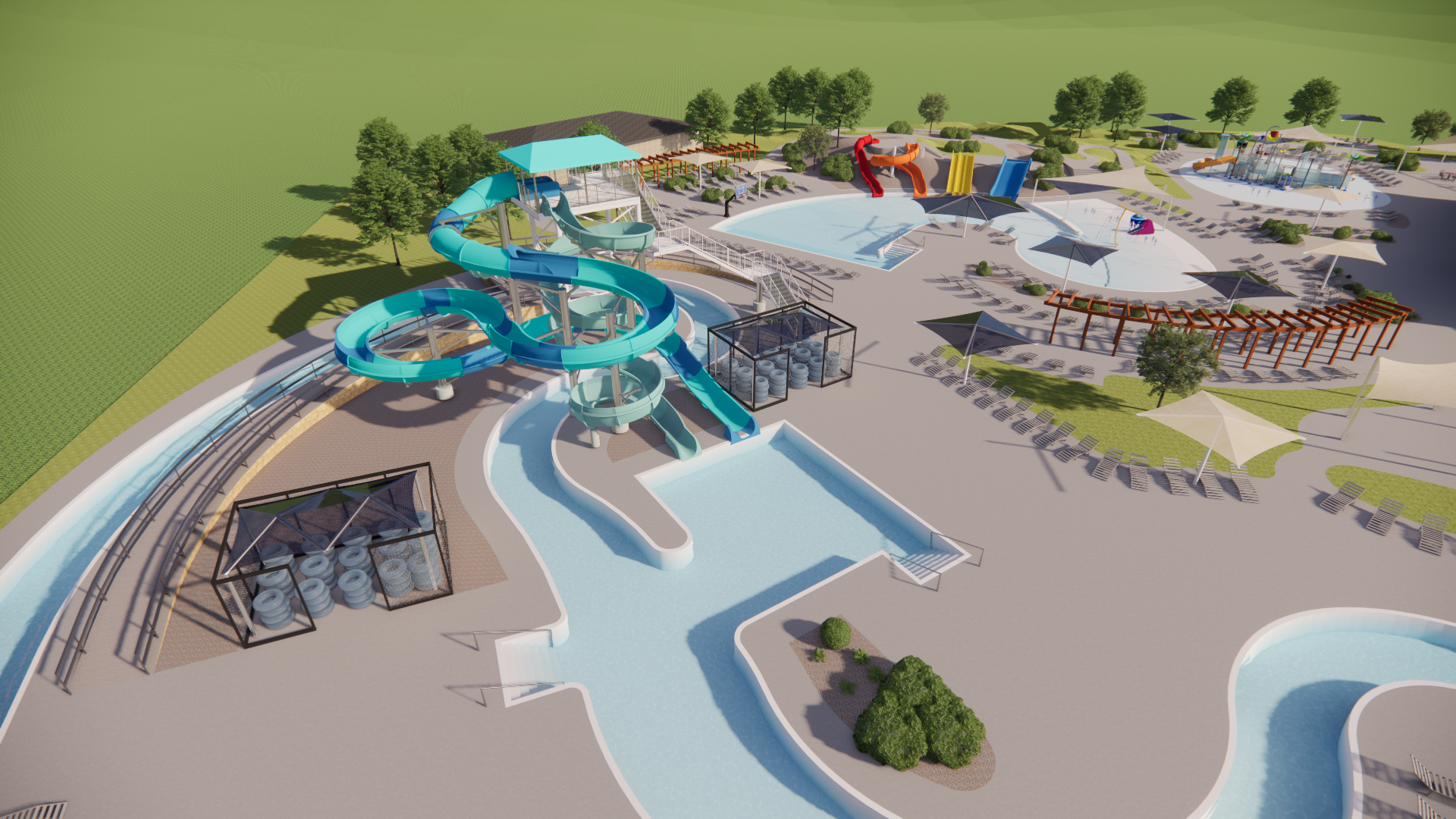 *Renderings of the aquatic center are used to represent the concept plan and help residents visualize what it may look like. These drawings are not final design, which come from the next phase if voters approve the bond referendum.
When would the aquatic center be built?
If the bond referendum is approved by voters, the project would move forward into design phase with an anticipated start to the construction phase in fall of 2025 and potential opening date in summer 2027.
Where would the aquatic center be located?
The proposed outdoor aquatic center would require 5–10 acres for the water facilities and parking lot. It would be located in the northwest corner of the future civic campus site, south of University Avenue and east of what is anticipated to become 11th Street in the future.
This land was purchased several years ago to create a new civic campus to support the needs of our growing community. The location within the site was selected based upon the size of the facility, anticipation of other planned facilities and planned street and utility improvements that will be constructed over the next several years. Future trail and pedestrian improvements will provide enhanced accessibility to the center and connectivity from north and east Waukee. Continued development is anticipated to the north and west, further establishing Civic Campus as a centrally located amenity.
What would it cost and how would the City pay for it?
The aquatic center project is expected to cost $33 million to build, including design, site preparation and construction of the facility. The City already owns the property where the facility will be built if the bond referendum is approved by voters.
The funding model for the project includes 60% from an increase to the City tax levy (property tax), 30% from current levy and 10% from other sources, such as local option sales tax and the public improvement fund. Like many other projects, City staff would seek out grants and explore other revenue sources, such as sponsorship opportunities, to cover costs.
Would this increase the property taxes I pay?
The funding model includes a property tax increase to cover 60% of the cost to build the facility. This would be about $34 per year per $100,000 valuation of a home. To determine the approximate annual tax increase for a property:
- Estimated valuation $_____ divided by 100,000 = ______ multiplied by $34 = $_______.
- Example: $350,000 / 100,000 = 3.5 x $34 = approximately $119 increase for annual property tax.
Note that property taxes are composed of levies (tax rates) from several taxing entities, including the school district, county, city, state and others. Changes to any of those levies or the rollback percentage determined by the state each year can increase or decrease how much property tax you pay. To learn more about how property taxes work, watch Property Tax 101
In accordance with State law, the City would borrow a maximum of $35 million for this bond referendum, and the City of Waukee portion of the tax levy would have an estimated tax impact of $57.86 per $100,000 valuation. However, as noted in the examples above, the funding model is built around using other revenues sources for 40% of the project cost, leaving the 60% tax increase of approximately $34 annually per $100,000 in valuation.
What is the voting process for the bond referendum?
Waukee residents will see this language on their ballot when they vote on Tuesday, November 5, 2024:
- Shall the City of Waukee, State of Iowa, issue its General Obligation Bonds or Capital Loan Notes in an amount of not exceeding the amount of $35,000,000 for the purpose of acquisition, construction, improvement and equipping of a new aquatic center, including parking lot and related site improvements?
Each voter will have the option to choose Yes or No. If 60% of voters approve, the bond referendum passes, and the aquatic center will move forward.
What is a bond?
Municipal bonds allow cities to fund major projects such as roads, parks, facilities and other capital expenses. Bonds are issued and repaid over an extended period of time, similar to the way many buyers finance the purchase of a home with a mortgage loan from a bank.
For this project, the City of Waukee is asking voters if they support the City borrowing up to $35 million to build an outdoor aquatic center. The City would pay back the bond using revenue from an increase to the City’s levy rate on property taxes, as well as portion of the current Debt Service Levy, Local Option Sales Tax and Project Improvement Fund revenues.
Why is the City considering a pool?
Waukee’s population is growing as are communities surrounding Waukee. Currently, the City does not have a public pool facility, so residents travel to other communities to use aquatic facilities. Residents routinely request a local aquatic facility to City Council and City staff, so the City of Waukee conducted a feasibility study. The final report indicates that market demand could support a facility. In a public survey during the feasibility study, 89% of survey respondents said they had visited a pool within the last 2-3 years, and 61% said they would use a Waukee aquatic center at least once per week. 78% of respondents indicated they live in Waukee city limits with another 18% outside city limits but within the Waukee Community School District.
An aquatic center aligns with the City's Imagine Waukee 2040 plan, particularly for these themes outlined for the future of Waukee Parks and Recreation:
- Build new signature Parks and Recreation and civic features
- Plan for future City Campus to potentially include an aquatic center and other recreational amenities
- Develop a park system that establishes Waukee as a regional destination for outdoor recreation
- Provide recreational programming that serves all segments of the Waukee community
Other neighboring cities have pools or aquatic centers. The YMCA has a pool in Waukee, and the school district just opened a new natatorium (indoor pool). Why would the City build a pool?
As part of the feasibility study, the research team talked with representatives from the Waukee Community School District (WCSD) and the Waukee Family YMCA to understand current aquatic services in Waukee and how a new outdoor aquatic center could enhance, grow, and work with existing services without undue competition and dilution of service.
The Waukee Community School District recently opened an indoor pool facility called a natatorium, which is not open to the general public. The YMCA pool is open to members. This proposed outdoor aquatic facility would be open to the general public and would expand leisure swimming opportunities. The school and YMCA facilities would continue to meet competition swimming needs.
There are 27 cities in Iowa with a population of 20,000 or more. Only three currently do not have swimming pools or aquatics centers of any kind.
Operations
How much water does this use? Why would Waukee build a pool when we are often told to cut irrigation during the summer?
The proposed facility is projected to use 10,000-15,000 gallons of water per day, including swimmer splash out, restroom demand and concession needs. Additionally, environmental and weather factors would impact evaporation.
Recirculation technology is part of the proposed design. This captures water from features, treats (cleans) it and reuses that water to lessen the amount of water needed to operate an aquatic center. Regenerative pool water filtration systems allow for smaller pool mechanical rooms, less water waste, reduced chemical waste and reduced heat loss to make this a more sustainable facility. In addition, the design will work to incorporate innovations in pool water heating systems and pumping systems that have reduced energy consumption and allow for longer equipment life. The design phase would look at other innovations and technologies that may become available in the coming years.
The City of Waukee has a Water Conservation Plan that can be activated in times of water shortage, such during a drought. If this aquatic center project moves forward, the City would look at how to incorporate the facility into conservation efforts when needed.
How long can a pool operate each year?
The projected operating season for the proposed aquatic center is anticipated to be Memorial Day to Labor Day. From approximately mid-August to Labor Day, there would be an adjusted schedule due to school going back in session.
What would it cost to use the aquatic center?
Exact costs to use the facility would be determined based on the market if this project moves forward after the bond referendum in November. Like other recreation programs and rental facilities, City staff would continually evaluate the cost of day passes, annual passes, rental fees and program fees in comparison with other area aquatic centers to remain competitive. Based on the feasibility study estimates, season passes could be around $100 for an individual or $225 for a family. Day passes could range from $3-10 per person based on age. These are estimates based on market rates in 2023 and could change by time of opening.
How would the City pay for maintenance and operations of the facility?
It is projected that the new aquatic center will bring in approximately $435,000-$644,000 in annual revenue. The facility will earn money to pay for operations and maintenance through entry fees, programs, rentals and concessions. Projections estimate that this will cover 80-95% of operating costs. The remainder would be part of the Parks and Recreation annual budget, similar to other amenities, such as parks, trails and the splash pad in Fox Creek Park.
The proposed aquatic center would cost around $600,000 to operate each year based on current estimates. That includes staff, water treatment chemicals, lighting, concessions, general maintenance of equipment, etc.
How would the City staff the aquatic center?
The proposed aquatic center is projected to use 25 to 33 staff members at any given time. The breakdown of positions for an average day includes:
- Pool Manager: 1
- Head/Lead Lifeguard: 1
- Lifeguards (on pool): 16-18
- Break/First Aid (Lifeguards): 5-7
- Admissions: 1-3
- Concessions: 1-3
The lifeguard position will require the greatest number of staff. At 20 hours per week per lifeguard, the new aquatic center would need to hire approximately 50-60 lifeguards each season.
Would the City guarantee that the aquatic center will be adequately and safely staffed at all its listed open hours every year?
The City of Waukee has filled all seasonal positions in the last few years, and the Human Resources department will work on a staffing plan to recruit the necessary employees. City staff would work to ensure that staffing could support the open hours of the aquatic center. However, given the many factors that go into operating an outdoor center, including staffing, weather and equipment operations, the City could not guarantee that the center would never have to reduce hours or close temporarily.
What is the maximum occupancy of the aquatic center?
The maximum occupancy of the facility is estimated to be approximately 1,570 people. Based on benchmark facilities and the revenue projected, annual attendance is expected to be in the 94,000 range, with an average daily attendance of approximately 990 guests.
Features and Amenities
Would there be shade?
Shade came up frequently in public input gathering. The design includes shade throughout the facility.
Would there be chairs, grass areas and other places to put stuff when chairs are full?
The concept plan has seating areas throughout the facility, including chairs, cabanas, shelters, grassy areas and picnic tables.
Would there be ample seating for the elderly, such as benches along the way to rest while walking from one section of the park to the other?
In the concept plan, seating is included throughout the facility, and ADA-accessibility is considered to ensure people of varying abilities can safely navigate the facility.
What accessible features would be included for people with disabilities?
There is an ADA-compliant lift into one of the pool areas and an ADA-accessible play structure in the area for small children. In addition, one of the bridges over the lazy river meets ADA-requirements so visitors can get to the center area.
Would there be an adults-only area?
Separate bodies of water can serve varying groups of people. The facility concept is set up to provide a more active area (leisure/kiddie pool, lazy river, slides and deep water) and a more relaxed, quiet area (separated lap pool). For example, the lap pool could be used for open swim, scheduled programs and designated times for adult-use only. In addition, there may be programs specifically for adults.
Would there be swim lessons or other programs?
Programming was a key component of the feasibility study. Exact programming would be determined by community need, staffing and other factors. Swim lessons would be a high priority when designing programs based on public input during the study.
Could I rent it for a birthday party or other event?
The plan includes facilities that would be available for rent, similar to pavilions and shelters in City parks. Current City-owned facilities around the City open to public rental are frequently booked, so this project would add new options for birthday parties, family reunions, corporate events and other gatherings.
Background and History
Hasn't Waukee voted on a pool before?
Yes. Waukee voters last had a referendum on the ballot in 2010. Waukee was much smaller then with a population a little under 14,000 people, so the pool design was smaller than the referendum on the ballot in 2024. Today, Waukee is home to an estimated 31,000 people and continues to add around 7 people per day. The pool design associated with this bond referendum reflects a facility that could serve Waukee today as well as into the future.
The 2020 referendum was 51% in favor, but this type of referendum requires 60% voter approval to pass.
About the Aquatic Center Feasibility Study
In 2023-2024, the City of Waukee conducted an Aquatic Center Feasibility Study to assess community need and support for an outdoor pool facility. This study was prompted by residents' questions and comments to city council members. The study team was asked to develop an aquatics plan that could meet community needs now and into the future while maximizing operational and financial sustainability.
An Aquatic Center Steering Committee was formed to provide resident input. In addition, the study team collected public feedback through an online survey, public input meetings and meetings with key groups, such as the school district and the YMCA. Consultants at Waters Edge Aquatic Design evaluated other area pools, public feedback and demographic trends within Waukee to provide a recommendation on the type of aquatic center facility that would best suit the community.
City Council reviewed the final report and voted to add a bond referendum to the ballot in the November election to ask residents if they support or oppose issuing a bond to pay for part of the project.